Learn
How much do tennis prices really swing? What 150,000 live minutes show
I recorded the live prices of 992 ATP and WTA matches on Polymarket over two weeks in October 2026, about 150,000 minutes of live play. Most of the time the price barely moves. About once an hour in a live match it jumps 10¢ or more in a single minute, and after that jump it keeps going more often than it snaps back.
This is the data side of why the price jumps on a break of serve, which uses a model. Here I wanted to see what the market actually does. One honest warning first: my data has prices but no scores, so I can't tell you which jumps were breaks of serve. I measured the swings themselves, and I explain exactly how below.
The data I used
The 77 Tennis scanner saved the price of every listed tennis match roughly every 18 seconds from 5 to 19 October 2026. That's 4.86 million price readings across 1,027 matches. 992 of them had live play in the window: 708 men's matches and 284 women's.
The price is the Polymarket midpoint, halfway between the best offer to buy and the best offer to sell, in cents. For each match I followed one player and took the last price in every minute of live play.
A normal minute: almost nothing happens
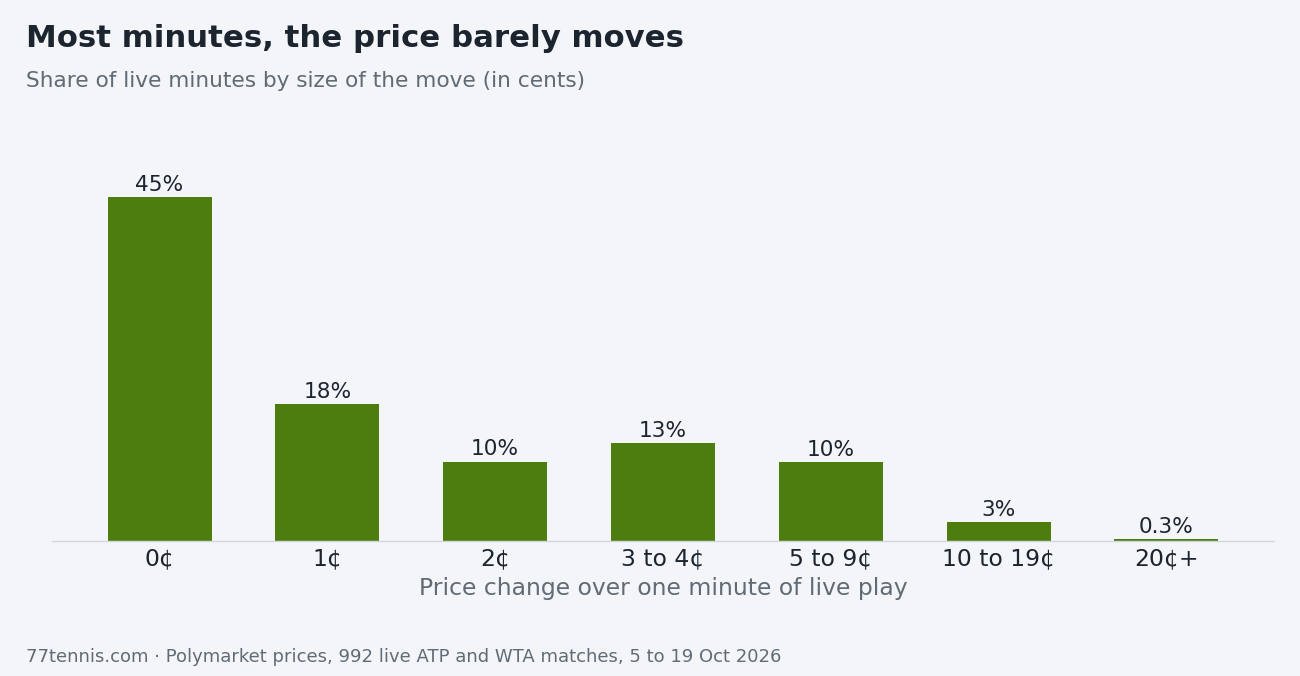
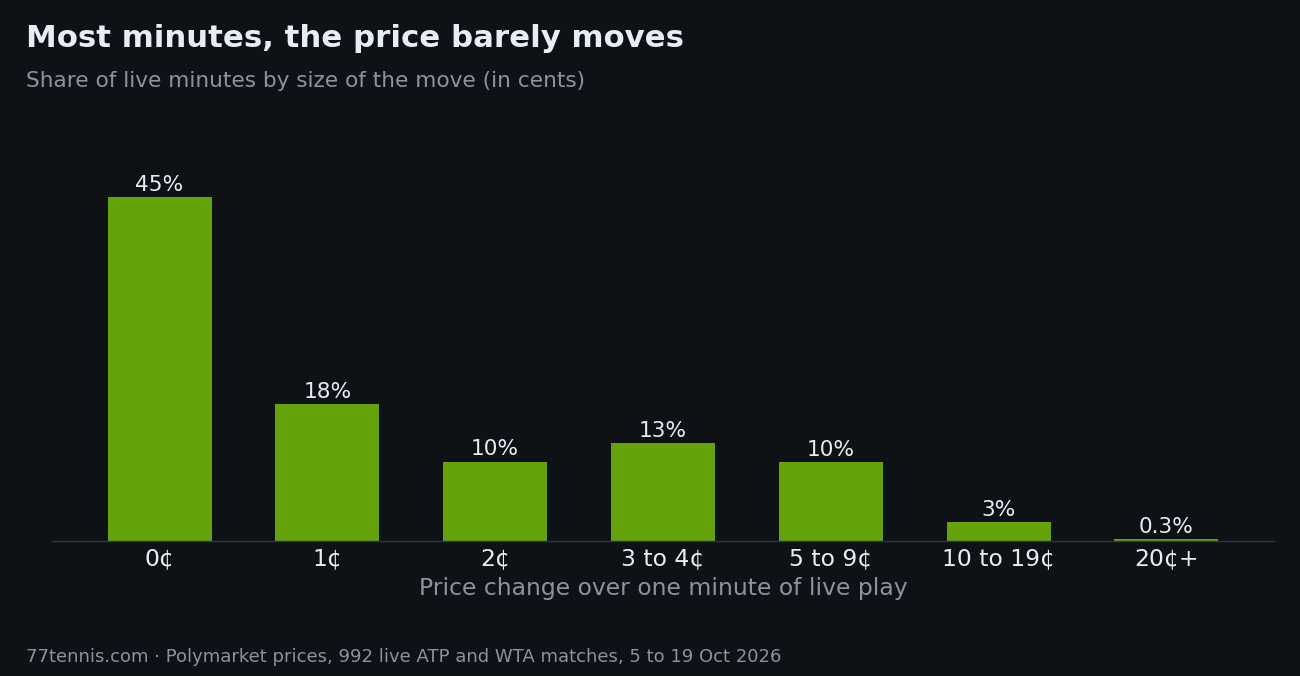
In 45% of live minutes the price didn't move at all, and in another 18% it moved by 1¢. Nine minutes in ten moved 5¢ or less. A move of 10¢ or more in one minute happened in fewer than 3 minutes out of 100, and a move of 24¢ or more in about one minute in a thousand.
That fits how tennis works. Most points don't change much, and a lot of minutes are spent on change of ends, towels and serves that go the expected way. The big moves are rare, and they're the ones people remember.
Big swings: about one per hour
I counted a "big swing" whenever the price moved 10¢ or more within one minute, and I counted at most one per match in any five minutes so one wild game isn't counted three times. That gave me 2,298 big swings, or about 0.9 per hour of live play.
The typical big swing was 12.5¢. One in ten was 19¢ or more. Those are the moves you'd expect around a break of serve, a set point or a medical timeout, but I can't say which was which.
Women's matches swung more. 17% of live minutes in WTA matches moved 5¢ or more, against 12% in ATP matches, and WTA matches had about 1.0 big swing per live hour against 0.9 for ATP. Breaks of serve are more common in women's tennis, so that's what I expected to see.
What happens after a big swing
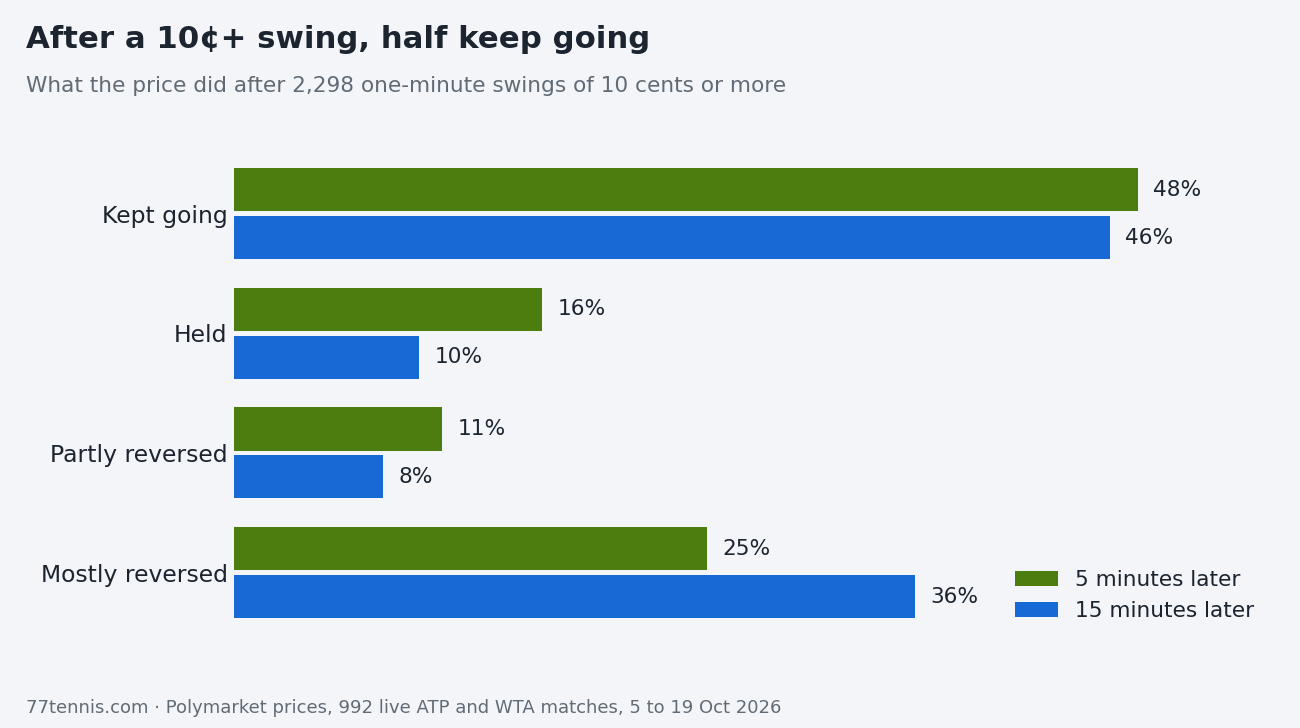
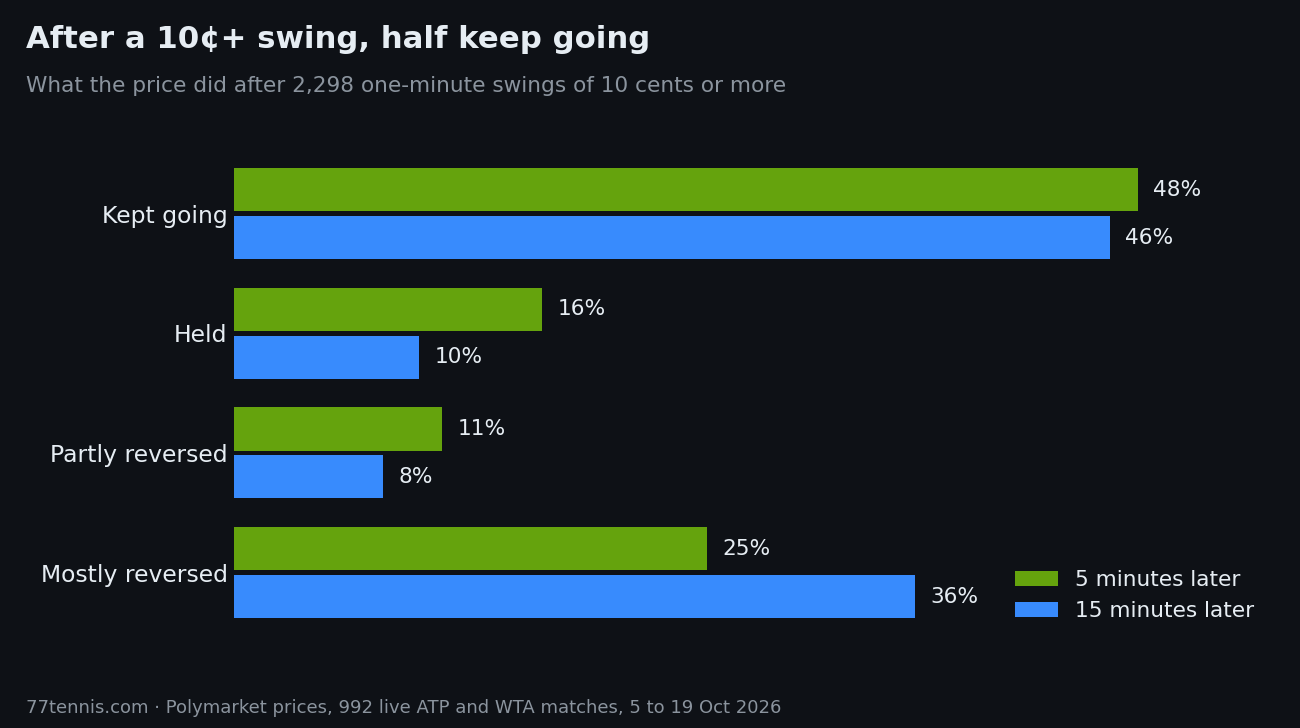
This is the part I found most useful. I looked at the price 5 and 15 minutes after each big swing and sorted what happened into four groups:
- Kept going: the price moved further the same way, by more than a tenth of the swing.
- Held: it stayed roughly where the swing left it.
- Partly reversed: it gave back between a quarter and three quarters of the swing.
- Mostly reversed: it gave back three quarters or more.
Five minutes later, 48% had kept going and only 25% had mostly reversed. After 15 minutes, 46% had kept going and 36% had mostly reversed. So a big swing was about twice as likely to carry on as to snap back in the first five minutes. Given more time, more of them did come back, which is what you'd expect when a player breaks back or wins the next set.
The idea that every sharp move is an overreaction doesn't hold up here. Most big moves were followed by more of the same, at least for a while.
Does the price level matter?
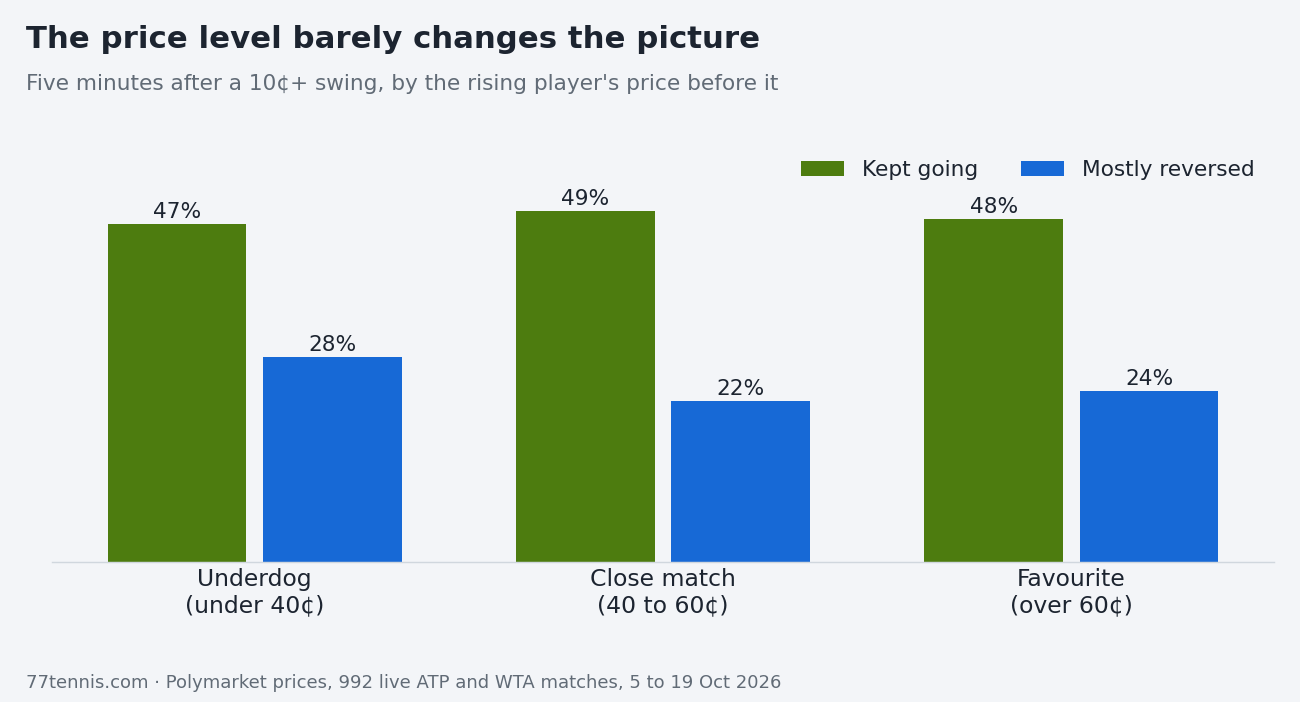
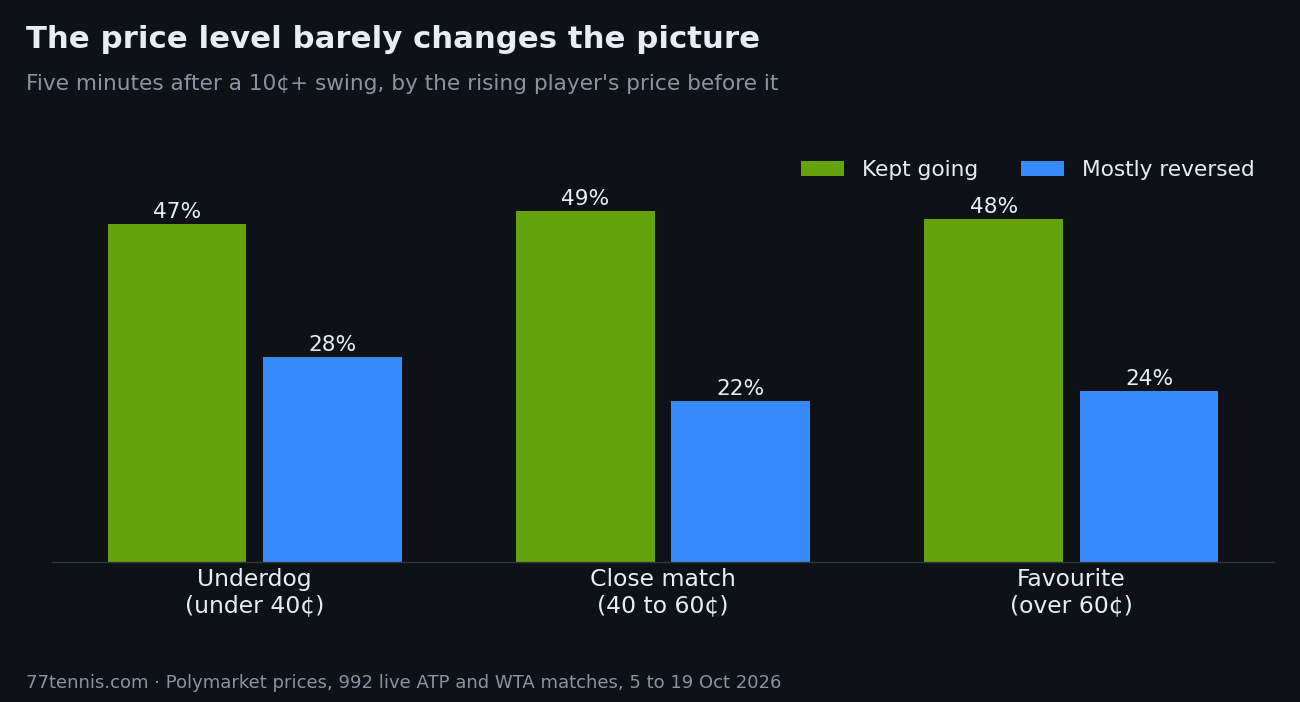
I split the big swings by the price of the player who gained, just before the swing. It made less difference than I thought. When an underdog jumped, the move was mostly reversed within five minutes 28% of the time. For close matches it was 22%, and for favourites 24%. In all three groups, close to half the swings kept going.
Underdog surges came back a little more often, which makes sense: an underdog can win a game or two without being the better player. But the gap is small, and 2,298 swings over two weeks isn't enough to build a strategy on that difference alone.
How I measured it, and what it can't tell you
- No scores. The archive has prices only, so I can't label a jump as a break, a set or an injury. Everything here is about price moves, whatever caused them.
- "Live" is a guess from the prices. I treated an hour of a match as live when its price took at least four different values and moved at least 2¢. I checked that rule against matches the scanner had marked as live or upcoming, and it matched, but a few pre-match minutes will have slipped in.
- Minute steps. Prices were saved about every 18 seconds and I used the last one in each minute. A spike that came and went inside a minute isn't counted.
- Midpoints, not trades. The midpoint is between the buy and sell prices. You'd buy a little higher and sell a little lower, and on thin markets that gap can be several cents.
- Near the end. I left out minutes where the price was below 3¢ or above 97¢, so the final collapse at match point isn't counted as a swing.
- Two weeks only. October 2026, mostly smaller events and indoor hard courts. Other surfaces and bigger tournaments may behave differently.
What I take from this
- Don't fade every big move. A sharp jump was more likely to keep going than to reverse in the next five minutes. Betting against it by reflex would have been wrong more often than right.
- Give it a few minutes. The share that reversed grew from 25% to 36% between 5 and 15 minutes. If you think a move went too far, waiting for the next game or two usually tells you more than the first few seconds.
- Expect quiet. Most minutes move 1¢ or less. If you need a big move to make your trade work, you may be waiting a long time.
- Size for the swings. One in ten big swings was 19¢ or more. A stop that's 5¢ away can be jumped straight over in a single minute. Read take profit and stop loss before you rely on one.
- Women's matches move more. That isn't good or bad, but it means wider swings in both directions.
Worked example: a stop inside one big swing
You buy 50 shares at 55¢, which costs $27.50, and plan to sell if the price drops to 50¢. That's a planned loss of $2.50.
Then your player is broken and the price drops by a typical big swing, 12.5¢, within a minute. The next price your stop can sell at is about 42¢, so you get $21.00 back and lose $6.50, not $2.50.
Nothing went wrong with the stop. The price simply never traded at 50¢. That's why I size trades for the swing I might get, not the stop I'd like.
If you want to try reading these swings yourself, the 77 Tennis demo shows live prices and scores side by side with $1,000 of demo money, and trading the break of serve walks through one way to approach them.
FAQ
How much does a tennis price usually move in a minute?
Very little. In my data, 45% of live minutes had no price change and another 18% moved 1¢. Nine minutes in ten moved 5¢ or less.
How often does the price jump 10 cents or more?
About once per hour of live play, a little more often in women's matches. Fewer than 3 minutes in 100 had a move that big.
Do big price swings in tennis usually reverse?
Not right away. Five minutes after a 10¢+ swing, 48% had kept going and 25% had mostly reversed. After 15 minutes, 36% had mostly reversed.
Can you tell which swings were breaks of serve?
Not from this data. It has prices but no scores, so I measured the swings themselves. Many big swings will be breaks, but some will be sets, injuries or a big order on a thin market.
Where does the data come from?
From Polymarket's public tennis markets, recorded by the 77 Tennis scanner about every 18 seconds from 5 to 19 October 2026. I'm not affiliated with Polymarket.
Demo only. 77 Tennis uses demo money with no cash value. Nothing here is financial or betting advice. Prices come from Polymarket's public tennis markets, and I'm not affiliated with Polymarket. Prediction markets aren't legal everywhere, so check the rules where you live. If trading stops being fun, stop.
Keep reading
- Learn
Why the price jumps on a break of serve (and when it overreacts)
How much a break should move the price, and when the market overdoes it.
6 min read - Strategies
Take-profit and stop-loss for tennis trading: how to set them
Where to put your exits, why stops fill late, and simple rules to start with.
6 min read